Do Polymarket Whales Actually Win? We Checked 1,845 Wallets That Bet $25K+
Everyone assumes a bigger bet just means a bigger gamble. The real numbers say it depends how big — and for most whales, the odds are a lot closer to a coin flip than we first reported.
Correction, 4 October 2026
The original version of this article said that 77.9% of whale wallets are net profitable, +$524.9M combined, and that the share stays at 75–80% in every bet-size tier. Those numbers were wrong.
We had calculated each wallet’s profit from Polymarket’s closed-positions data. It only lists positions that were sold or redeemed — and losing positions that expire worthless are usually never redeemed, so most of the losses were missing. The bet-size chart also did not follow its own caption: its tiers were closer to each wallet’s total volume of $25K+ trades than to its largest single trade.
This version uses Polymarket’s own all-time profit-and-loss figures for every wallet, with no filtering, and groups wallets by their largest single trade. We replaced the charts and rewrote the text. The headline changes from “whales don’t lose” to “roughly a coin flip — except at the very top.” We’re sorry for the error.
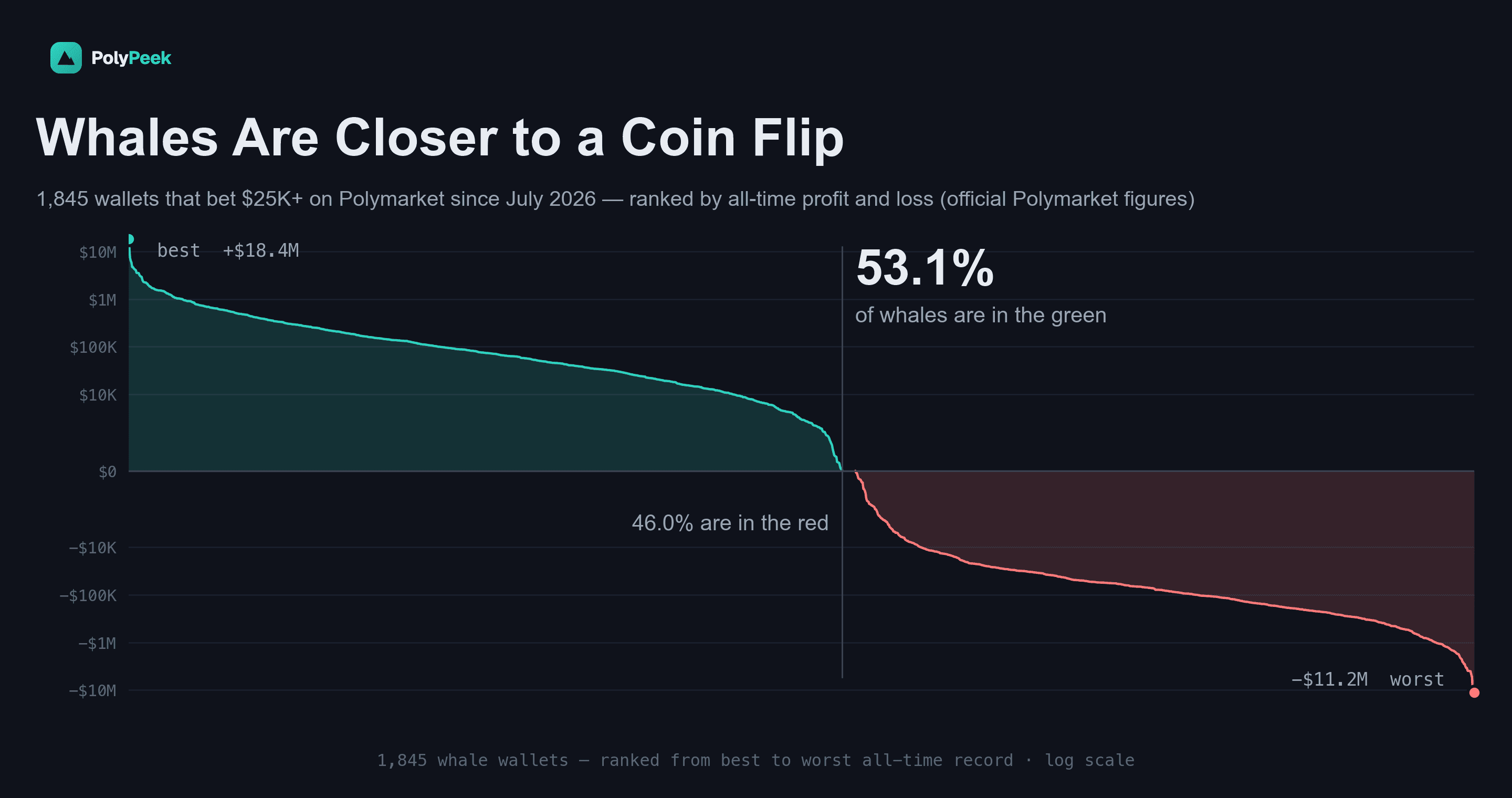
The usual read on a giant Polymarket bet is that someone is either extremely confident or just playing with bigger chips — and either way, size alone doesn’t tell you whether they’re actually right. So we checked. We pulled every wallet that has placed at least one trade of $25,000 or more since PolyPeek’s whale tracker went live in July 2026 — 1,845 wallets — and looked up each one’s all-time profit and loss as published by Polymarket itself. No minimum track record and no filtering: every wallet counts, including the ones that traded only once or twice.
The numbers
979 wallets — 53.1% — are net profitable. 849 (46.0%) are net negative, and 17 sit at exactly zero. Added up, the winners made $321.1M and the losers lost $249.3M: about $1.29 won for every $1 lost, or +$71.8M net. The median wallet is up just $2,916.
Those profits are concentrated. The ten most profitable wallets account for 22.7% of all gains ($73.0M), and the top 100 for 64.9%. Take the top ten out and the whole group is roughly break-even (−$1.2M).
Recent form doesn’t help the “whales don’t lose” story either. Over the last 30 days, 49.6% of the 1,394 wallets with activity in that window made money — and together they lost $119.0M, almost entirely because of ten large losers (−$103.2M). These figures include open positions at their current value.
It depends how big
Split the same 1,845 wallets into six tiers by the size of their largest single trade, and the picture changes.
Below $50K a whale is a coin flip: 48.6% are in the green and the median wallet is down $308. The share climbs with every step — 54.9% at $50K–$100K, 57.0% at $100K–$250K, 66.7% at $250K–$500K and 75.0% at $500K–$1M — and reaches 84.2% for the 19 wallets whose biggest bet was $1M or more. What also scales is how much the typical wallet makes: the median is +$21.7K at $100K–$250K, +$357K at $500K–$1M and +$645K at $1M+.
What this does — and doesn’t — tell you
Selection cuts both ways. Wallets that win big can afford bigger bets, so part of this is bankroll, not skill. The largest tiers are small samples and may include professional market makers or one operator running several wallets.
These are all-time figures, not just the period since July, and they include open positions at current prices. A wallet can be up thanks to history we didn’t observe.
Correlation, not causation. Placing a bigger bet does not make you more likely to win it — the two simply travel together, and we can’t say which way the arrow points.
What this means if you’re watching the whale feed
A $25K bet on its own tells you very little: at that size, about half of the wallets behind it are net losers. The signal gets stronger with size — above $250K roughly two in three have a winning record, and above $500K three in four or more — but those tiers are small, and nobody can tell you the next trade is one of the winners. Treat a large trade as a reason to open the market and ask why, not as a position to copy.
See it live
Data and method
PolyPeek is an independent analytics project and is not affiliated with, endorsed by, or sponsored by Polymarket. Nothing here is financial advice. Past performance, even at this sample size, is not a guarantee of future results.