Why the Whale Alert Can Be Gold: Reading Insider-Grade Signals on Polymarket
Markets don't move on news. They move on the expectation of it — and someone always expects it first.
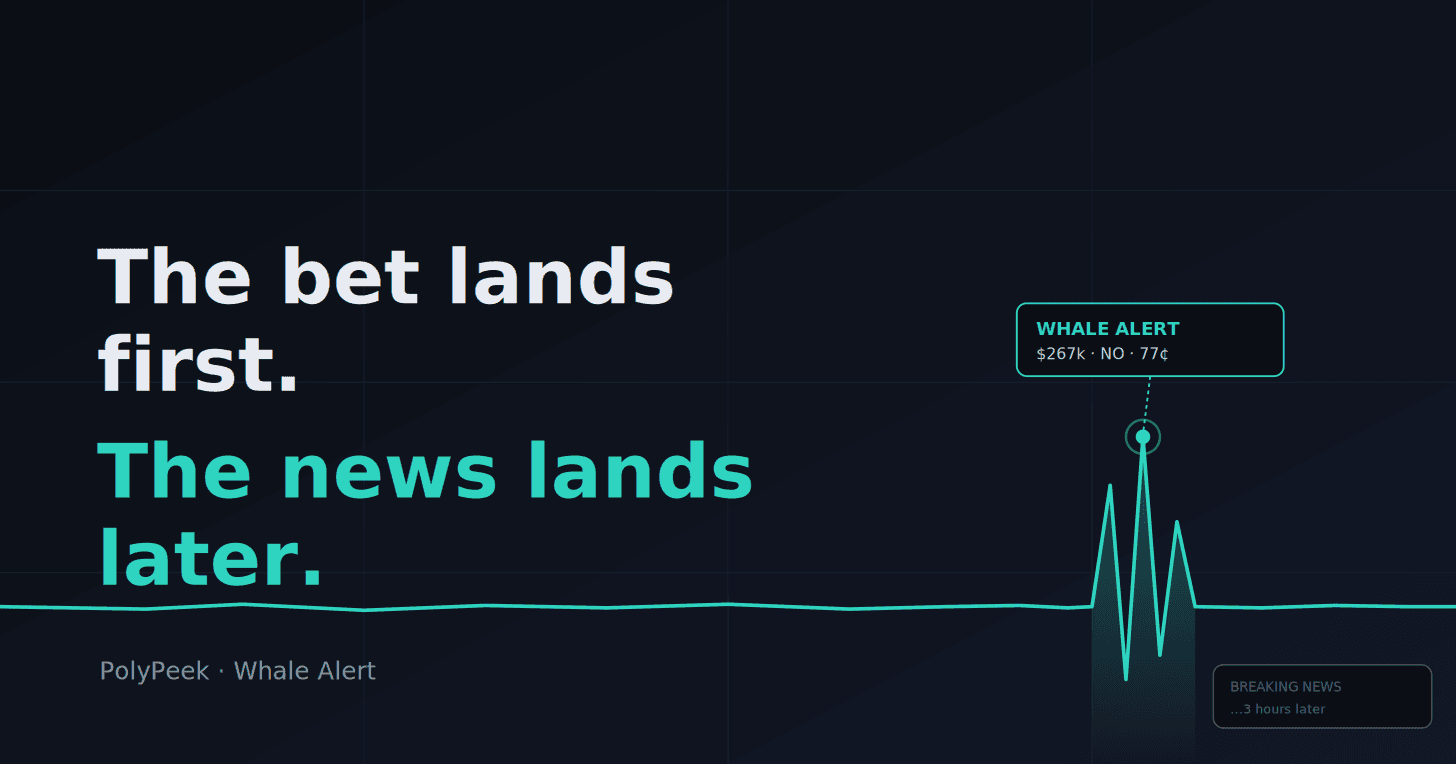
By the time a headline hits your feed, the people who already knew have often placed their bets. A staffer who saw the memo. An insider who sat in the room. A trader with a source. On a normal exchange that early positioning is buried in anonymous order flow. On Polymarket, every trade settles on a public blockchain — which means a large, well-timed bet leaves a footprint anyone can see.
PolyPeek's Whale Alert is built to catch exactly that footprint the moment it lands. This is the case for why it can be worth its weight in gold — and, just as importantly, how to read it without fooling yourself.
Money talks before mouths do
Consider how information actually travels. A decision gets made privately. A small circle knows. Then, eventually, it becomes public. That gap — between “some people know” and “everyone knows” — is where informed money operates.
If someone is confident about an outcome the public hasn't priced in yet, the rational move is to bet on it now, while the odds are still cheap. A large position appearing hours before an announcement isn't proof of insider knowledge, but it is the kind of thing that, in hindsight, often lines up suspiciously well with what happened next.
This isn't hypothetical. Prediction markets have repeatedly shown probability shifts that precededthe official news — election calls, policy decisions, resignations, geopolitical turns where the order book moved before the press release. The whales weren't guessing. They were positioned.
Why a large trade is worth a second look
Not every big trade is a signal. Plenty are noise — a fund rebalancing, someone hedging an unrelated position, or a trader who is simply wrong with a lot of conviction. So why watch them at all?
Because size, timing and asymmetry together are a filter. Take a real one from our feed. On 1 August 2026, a wallet called Detailed-Poison put $267k on No in the market “Will the U.S. invade Iran before 2027?” — at an entry price of 77¢. That single trade tells you a lot if you know how to read it.
The size ($267k) is real conviction, not a rounding error. The direction (No) is a bet against escalation. And the asymmetry is the tell: paying 77¢ to win 30% is not a punt on long odds — it is someone putting six figures behind the view that a scary-sounding outcome won't happen, at a price the crowd already considers likely. When a trade like that lands right before a scheduled event — a speech, a vote, a data release — the pattern becomes worth investigating.
It works in the other direction too. The same week, as the 2026 World Cup ran, our feed caught $839k on Spain and $584kon Argentina to advance — conviction bets on the favourites, placed while the price was still moving. The Whale Alert doesn't tell you why someone bet. It tells you that they did, how much, on which side, and exactly when. From there, you look closer.
What PolyPeek shows you the moment a whale moves
Because Polymarket runs on public infrastructure, PolyPeek can surface the details that matter for reading intent:
- Size and direction — how large the position is, and whether it is a Yes or No conviction bet.
- Timing — the exact moment the trade hit, so you can line it up against the news calendar.
- The wallet — every trade links back to a public profile. You can follow a specific whale over time and see whether their large bets tend to land on the right side.
- The market context — where this trade sits relative to the current implied probability, so you can spot when someone is betting hard against the crowd.
A wallet that repeatedly takes big positions and repeatedly wins is telling you something. That is not a promise of insider access — but it is a track record, and track records are the closest thing to signal you will find in an anonymous market.
So do the big bettors actually win?
We checked. We took every wallet in our whale feed that had placed at least five trades of $50k or more, then looked at how their closed positions actually resolved. Filtering to wallets with a meaningful sample — at least 50 resolved positions — the leaders are striking.
The leaders land between 95% and nearly 99%. One wallet closed 195 of its last 200 positions in profit. Over that many resolved bets, a number like that is not luck — it is a wallet worth watching.
One honest caveat on what this measures
How to read a whale trade without fooling yourself
Here is the honest part, because the alternative is expensive.
A whale trade is a prompt, not a verdict. It is an invitation to open the market and ask why— not a green light to copy the position. Informed money and confident-but-wrong money look identical in the order book. The size tells you someone believes it; it doesn't tell you they are right.
- Correlation isn't proof — a big bet that precedes news looks like foreknowledge in hindsight, but you are seeing the hits and forgetting the misses. Track the wallet over many trades before you trust it.
- Check the market's liquidity — in a thin market, a “whale” trade might just be someone moving a price that had no depth to begin with — impressive on paper, meaningless as signal.
- Watch for the fade — sometimes a large trade spikes a probability and then immediately reverts as the market absorbs it. That tells you the size did not carry conviction the rest of the market shared.
- Follow, don't chase — the value in a whale alert is early awareness — knowing where to point your attention before the crowd does. That is very different from blindly mirroring a stranger's position.
Used this way, the Whale Alert becomes a research trigger: a live feed of where real money is taking real risk, filtered for the trades big enough to be worth a look.
The edge is being early, not being certain
You will never get certainty from a prediction market. What you can get is a head start — a way to notice that someone with skin in the game is positioning before the story is public, and to decide for yourself whether that is worth following.
That is the whole idea behind the Whale Alert. Not a crystal ball. A seismograph.
See it live
PolyPeek is an independent analytics project and is not affiliated with, endorsed by, or sponsored by Polymarket. Nothing here is financial advice. A large trade is not evidence of illegal insider trading, and we make no claim that any specific trader has acted on non-public information.